
Optimum nutrition is vital in infancy as it is a period of rapid growth and development. Dietary fats are a primary source of energy intake1 . Dietary fat intake should be approximately 30-35% of total energy 2 . The estimated average requirement (EAR) of visible fat for 6-12 months of age is 25g/day3 . Fat intake is usually in the form of triglycerides, fatty acids, phospholipids and cholesterol. Fatty acids are classified as essential (EFA) and non-essential fatty acids (NEFA). EFA includes linoleic acid (LA) and alpha-linolenic acid (ALA). 1
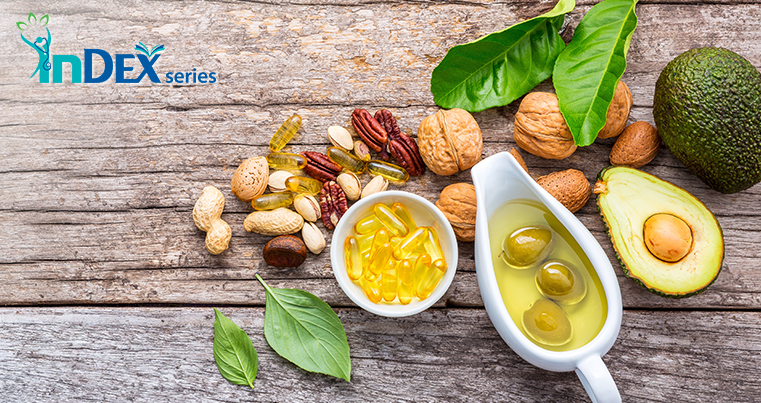
Classification of fat based on presence and number of double bonds is shown below:
|
Types of Fat |
||||
|
Saturated Fatty acids (SFA) |
Unsaturated Fatty acids (USFA) |
Trans Fats (TF) |
||
|
|
Monounsaturated Fatty Acid (MUFA) |
Polyunsaturated Fatty Acids (PUFA) |
|
|
|
Sources: Palm oil, coconut oil ,butter etc |
Sources: Olive oil, groundnut oil, rice bran oil etc |
Omega 6
Sources: safflower oil, sunflower oil,corn oil etc |
Omega 3
Sources: flaxseeds, walnuts, fatty fish, soybean oil etc |
Bakery and processed foods |

AA- Arachidonic acid, EPA- Eicosapentaenoic acid, DHA-Docosahexaenoic acid
Table 1: Classification of fats1
How are fats essential for growth? 1,4
- Essential source of caloric intake (9kcal/g)
- Involved in metabolic and physiological functions
- Structural component of cell membranes
- Aid in absorption of fat-soluble vitamins
- Source of EFA required for normal visual functions and neurodevelopment
- Develop infant’s immune system
Did you know?5
Although breast milk has fat content of 3.2 to 3.6%.
44 to 50% of total calories in the breast milk come from fats.
Dietary fats have a wide spectrum of biological actions beyond the provision of energy and are pivotal for infants’ growth, development, and health.
References:
- Patel JK, Rouster AS. Infant Nutrition Requirements and Options. [Updated 2020 Aug 14]. In: StatPearls [Internet]. Treasure Island (FL): StatPearls Publishing; 2021 Jan-. Available from: https://www.ncbi.nlm.nih.gov/books /NBK560758/
- Uauy, R., & Dangour, A. D. (2009). Fat and fatty acid requirements and recommendations for infants of 0-2 years and children of 2-18 years. Annals of nutrition & metabolism, 55(1-3), 76–96. https://doi.org/10.1159/000228997
- ICMR-NIN Nutrient RequirementsFor Indians 2020.Available at https://foodfuturefoundation.org /media/i0ld30zx/recommended-dietary-allowances-rda-for-indians-2020.pdf
- Delplanque, B., Gibson, R., Koletzko, B., Lapillonne, A., & Strandvik, B. (2015). Lipid Quality in Infant Nutrition: Current Knowledge and Future Opportunities. Journal of pediatric gastroenterology and nutrition, 61(1), 8–17. https://doi.org/10.1097/MPG .0000000000000818
- Ballard, O., & Morrow, A. L. (2013). Human milk composition: nutrients and bioactive factors. Pediatric clinics of North America, 60(1), 49–74. https://doi.org/10.1016/j.pcl.2012.10 .002.
- Ganapathy S. (2009). Long chain polyunsaturated fatty acids and immunity in infants. Indian pediatrics, 46(9), 785–790.
- Havlicekova, Z., Jesenak, M., Banovcin, P., & Kuchta, M. (2016). Beta-palmitate – a natural component of human milk in supplemental milk formulas. Nutrition journal, 15, 28. https://doi.org/10.1186/s12937-016-0145-1
- Bronsky, J., Campoy, C., Embleton, N., Fewtrell, M., Mis, N. F., Gerasimidis, K., Hojsak, I., Hulst, J., Indrio, F., Lapillonne, A., Molgaard, C., Moltu, S. J., Verduci, E., Vora, R., Domellöf, M., & ESPGHAN Committee on Nutrition (2019). Palm Oil and Beta-palmitate in Infant Formula: A Position Paper by the European Society for Paediatric Gastroenterology, Hepatology, and Nutrition (ESPGHAN) Committee on Nutrition. Journal of pediatric gastroenterology and nutrition, 68(5), 742–760. https://doi.org/10.1097/MPG .0000000000002307
CVM code: 1620807546934