
Important Notice
If you are a doctor, dietitian, nurse, pharmacist, then click on I’m a healthcare professional to proceed. For persons other than Health care professionals, we request you to visit www.danone.in.
To determine the nutritional adequacy, and growth-promoting efficacy of protein hydrolysate or amino acid-derived formulas (AAF) in infants with Cow’s milk allergy.
Extensively hydrolyzed whey formula (We) was compared with an AAF in a randomized, prospective follow-up study for 9 months.
We group: n= 22 infants (mean age of 6 months)
AAF group: n= 23 infants (mean age of 7)
Nutritional adequacy and growth were determined.
Both formulas were clinically and biochemically tolerated.
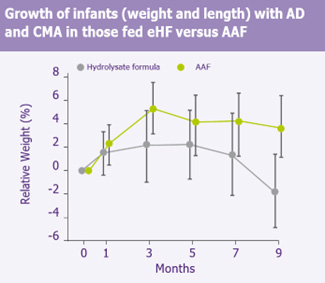
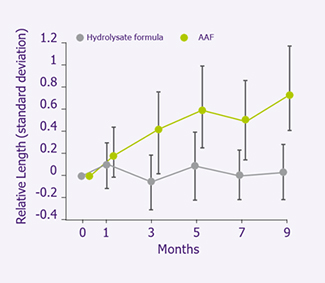
Extensively hydrolyzed formulas are safe and effective for most infants; an amino acid-derived formula may be preferable for infants with multiple food allergies, especially for the maintenance of normal growth
Isolauri E, Sutas Y, Mäkinen-Kiljunen S et al. Efficacy and safety of hydrolyzed cow milk and amino acid-derived formulas in infants with cow milk allergy. J Pediatr 1995; 127:550-557