By - Danone Nutricia Academy
Highlights
- The immune system can be influenced by various macro- and micronutrients.
- Foods rich in micronutrients, like vitamin C, should be offered to stimulate immune
function in children.
- Nutrition counseling should begin early in life to emphasize the importance of consuming
foods with immune-modulating properties and promoting healthy eating habits.
The immune system is a complex and diverse system that is affected by various factors, including
nutrition. One’s immunity is determined by both the quality and quantity of their immune response.
Micronutrients, such as vitamin C, are crucial in supporting the immune system’s effective
functioning, and it is essential to ensure adequate intake to reduce the risk of infections.
1,2
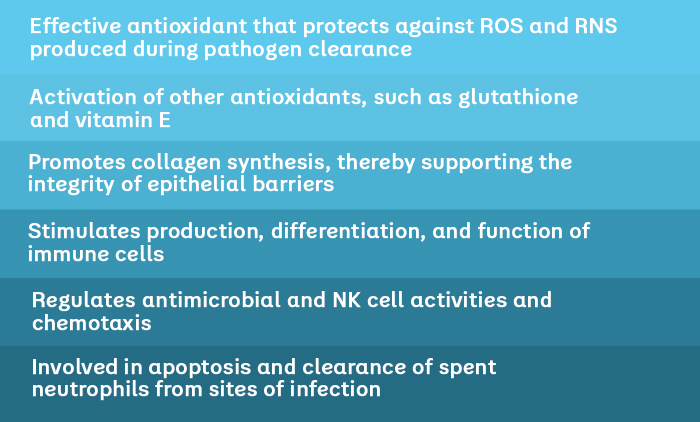
Immunomodulatory effects of vitamin C 3
Vitamin C deficiency
The recommended dietary allowance for vitamin C for children 1-3 years of age is 30 mg/day, and for
children 4-6 years of age is 35 mg/day. 4 Some sources of vitamin C include citrus fruits, Indian
gooseberry and leafy vegetables. 5 Several studies have been conducted in India to determine the
vitamin C levels of children of various ages. A study on preschool children reported that
malnourished preschool children in Jaipur city had a higher prevalence of vitamin C deficiency
compared to well-nourished children.
6
An inadequate intake of micronutrients at any stage of life can weaken the immune system, leading
to increased susceptibility to infections and more severe symptoms. Deficiency of vitamin C have
significant effects, including:
3
- Increased oxidative damage
- Increased incidence and severity of pneumonia and other infections
- Decreased resistance to infection and cancer
- Decreased delayed-type hypersensitivity response
- Impaired wound healing
Clinical evidence on the efficacy of vitamin C in children
Supplementation of vitamin C can shorten the duration and reduce the severity of symptoms of the
common cold in children. Vitamin C has also been reported to improve the outcome of pneumonia,
malaria, and diarrheal infections in children. 3 Vitamin C intake is associated with fewer allergic
rhinitis symptoms.
7
Conclusion
Vitamin C plays a key role in regulating several functions of innate and adaptive immunity. Its
deficiency has a negative impact on immune function and may increase the incidence and severity of
infections and pneumonia. Clinical evidence indicates that vitamin C can be beneficial for the
common cold, pneumonia, malaria, diarrhea, and allergic rhinitis in children.
References
- Pai UA, Chandrasekhar P, Carvalho RS, Kumar S. The role of nutrition in immunity in infants and toddlers: An
expert panel opinion. Clin Epidemiol Glob Health. 2018 Dec; 6(4):155-159
- Verduci E, Köglmeier J. Immunomodulation in Children: The Role of the Diet. J Pediatr Gastroenterol Nutr. 2021
Sep 1;73(3):293-298.
- Maggini S, Pierre A, Calder PC. Immune Function and Micronutrient Requirements Change over the Life Course.
Nutrients. 2018 Oct 17;10(10):1531.
- ICMR-NIN Expert Group on Nutrient Requirement for Indians,Recommended Dietary Allowances (RDA) and
Estimated Average Requirements (EAR) – 2020. Available at: https://www.nin.res.in/RDA_Full_Report_2020.html.
Accessed on 27 th February 2024
- Chambial S, Dwivedi S, Shukla KK, John PJ, Sharma P. Vitamin C in disease prevention and cure: an overview.
Indian journal of clinical biochemistry. 2013 Oct;28:314-28.
- Rowe S, Carr AC. Global Vitamin C Status and Prevalence of Deficiency: A Cause for Concern? Nutrients. 2020;
12(7):2008.
- Seo JH, Kwon SO, Lee SY, Kim HY, Kwon JW, Kim BJ, Yu J, Kim HB, Kim WK, Jang GC, Song DJ, Shim JY, Oh SY, Hong
SJ. Association of antioxidants with allergic rhinitis in children from seoul. Allergy Asthma Immunol Res. 2013
Mar;5(2):81-7.
For the use of healthcare professionals only. Not for general public.
CVM Code: 1716354505366