
Important Notice
If you are a doctor, dietitian, nurse, pharmacist, then click on I’m a healthcare professional to proceed. For persons other than Health care professionals, we request you to visit www.danone.in.
By - Danone Nutricia academy
Risk of infections and their severity change with immunological competence according to the way immune system develops and matures with age. Many factors, including nutrition, influence the immune system. Nutrition, infection, and immunity all have a bidirectional link where changes in one factor impacts the others. For instance, specific immunological characteristics present at different stages of life may alter the type, frequency, and severity of infections. In contrast, inadequate nutrition might impair immune function and raise the risk of infection.1
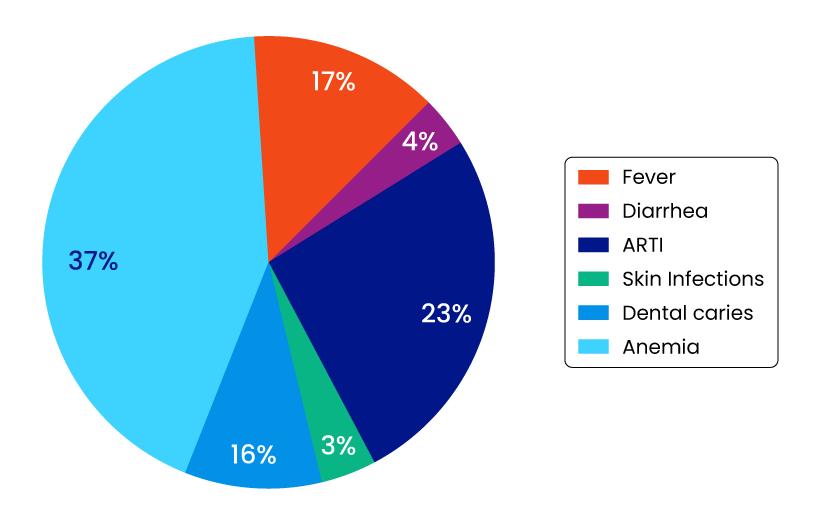
Several clinical studies have studied the morbidity pattern of preschool children in India. A recent survey of 381 children in the age group 3 to 6 years from Andhra Pradesh reported that the study population had the highest prevalence of anemia, followed by acute respiratory tract infections (ARTI). Morbid conditions also included fever, dental caries, diarrhea, and skin infections (Figure 1).2
A community-based surveillance study from a rural north Indian region studied the burden of ARTI in 2859 children aged 0–10 years. The ARTI incidence in 3 to 6-year-old children was 6.58 for boys and 6.14 for girls, whereas the incidence of acute lower respiratory tract infections was 0.14 for boys and 0.13 for girls.3
In another study, significant morbidities among 6–60 month-old children (n=605) from Raipur, central India, were reported to be ARI, anemia, and scabies.4
Immunocompetence requires essential micronutrients, including vitamins A, C, D, E, B2, B6, B12, folic acid, iron, selenium, and zinc. Micronutrient deficiencies are a recognized issue in global public health, and poor nutritional status increases the risk of certain infections.1
Evidence suggests that undernutrition severely weakens the immune system, leaving individuals vulnerable to infections and cytokine activation. Immuno-nutrient deficiencies can impair immune response at the cellular level, significantly affecting immune cell function and mucosal barriers. Infections, especially when the host’s nutritional status is compromised, can trigger immune system inflammatory cascades, further stressing the developing immune system and potentially leading to detrimental outcomes.5
An Indian study reported that major morbidities in children aged 6–60 months were ARI and diarrhea. Furthermore, it was reported that children with ARI were more likely to be malnourished than those with diarrhea.4
Distinct immune features are present during each life stage, and specific factors, such as nutrients, differentially affect immune function, resulting in different types and severity of infections with age. In India, preschool children show a high prevalence of morbid conditions, including ARI and diarrhea. Moreover, the incidence of ARI is associated with a malnourished state in young children. Realizing the severity of malnourishment among children, the Government of India has implemented several nutritional intervention programs to curb malnutrition and improve nutritional outcomes for children.
CVM code:1690279030411